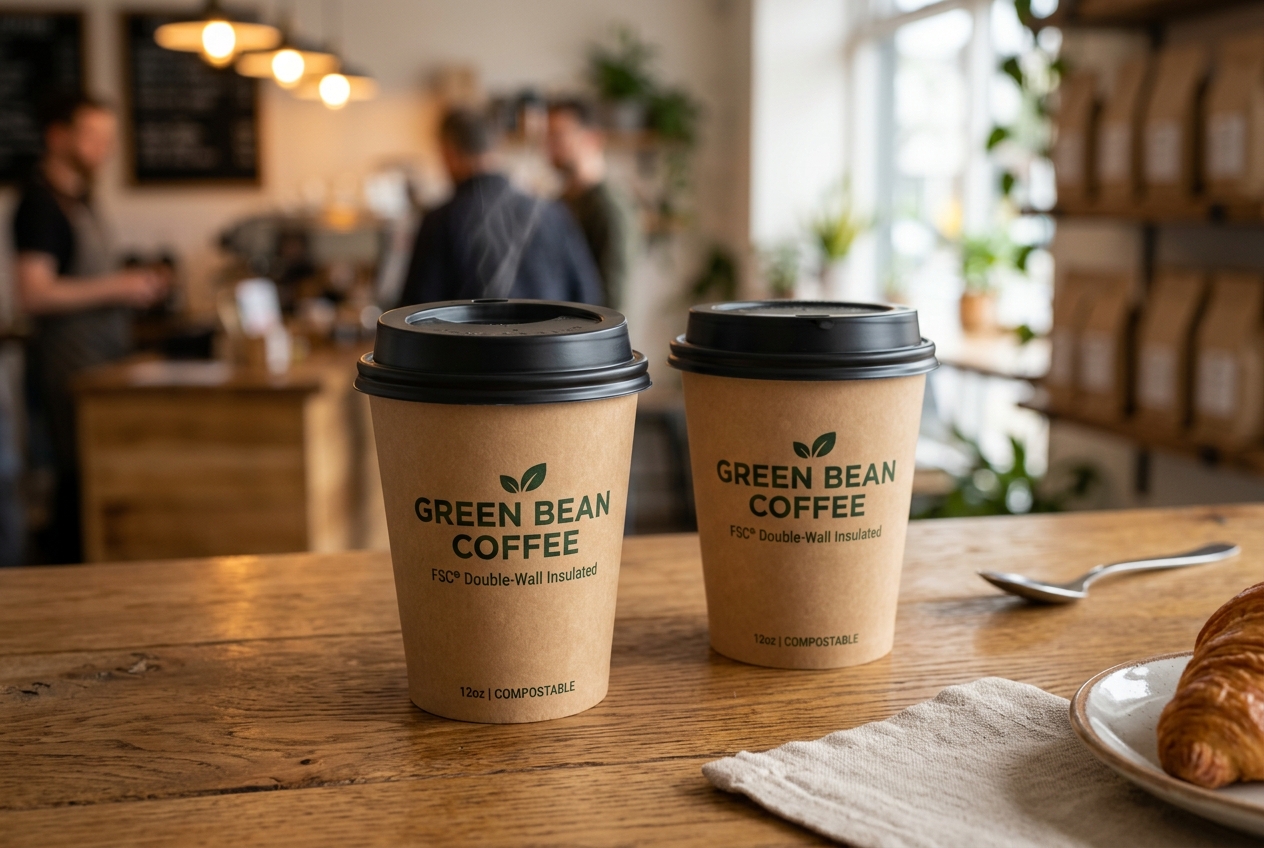
1. The Global Shift in Paper Coffee Cup Coating Technologies
For over half a century, polyethylene (PE) plastic lamination has dominated paper hot cup manufacturing. By melting a thin PE plastic film onto virgin paperboard, cup makers achieve liquid proofing at low cost. However, PE-lined cups cannot be recycled in standard paper mills; they require specialized chemical film-separation plants that are scarce globally.
Bio-plastic PolyLactic Acid (PLA), derived from fermented cornstarch, emerged as an eco-friendly alternative. Yet PLA presents critical operational hurdles: it requires industrial composting facilities operating above 58°C, breaks down poorly in ocean/landfill environments, and under the European Union’s Single-Use Plastics Directive (SUPD), is still legally classified as a plastic polymer, forcing brands to print mandatory “Plastic in Product” turtle warning logos on their cups.
Aqueous dispersion coatings solve this dilemma by applying a microscopic water-based acrylic/binder dispersion that dries into paper fibers without forming a separate plastic film sheet.
+-------------------------------------------------------------------------+
|                      PAPER CUP COATING MATRIX                           |
|                                                                         |
| 1. Traditional PE  : Paperboard + Melt Extruded Polyethylene Sheet      |
| 2. Bio-Plastic PLA : Paperboard + Cornstarch PLA Bio-Film Sheet         |
| 3. Aqueous Coating : Paperboard + Water-Dispersed Acrylic Polymer (No Film) |
+-------------------------------------------------------------------------+
2. Polymer Chemistry & Liquid Barrier Physics of Aqueous Coatings
Aqueous coatings utilize water-borne acrylic-styrene or bio-resin emulsions sprayed onto raw paperboard before cup forming. During high-temperature oven drying (140°C–160°C), the water carrier evaporates, leaving a continuous hydrophobic polymer network bound directly to the cellulose fibers.
2.1 Micro-Layer Structure
Unlike PE film (which forms a distinct 15–20 $\mu$m plastic sheet), aqueous dispersion forms a 2–4 $\mu$m hydrophobic matrix:
- Pore Penetration: Polymer particles flow into the capillary spaces between paperboard fibers.
- Surface Tension: Provides a high contact angle ($\theta > 105^\circ$) against hot coffee, acidic beverages (pH 3.0), and dairy fats.
Cross-Sectional View:
[ Hot Coffee (95°C) ]
────────────────────────────────────── (Contact Angle > 105°)
~~~~ Hydrophobic Aqueous Layer (2-4 µm) ~~~~
======================================
     Raw Virgin Wood Pulp Fibers (300 gsm)
======================================
3. Comprehensive Comparison Matrix: Aqueous vs PLA vs PE
| Performance Attribute | Water-Based Aqueous Coating | Bio-Based PLA Lamination | Traditional PE Lamination |
|---|---|---|---|
| Separable Plastic Film Sheet | Zero Plastic Film Sheet | Bio-Plastic Film Sheet | Polyethylene Film Sheet |
| EU SUPD Status (Directive 2019/904) | Exempt (No Turtle Logo Required) | Requires “Plastic in Product” Logo | Requires “Plastic in Product” Logo |
| Recyclability Standard | EN 13430 / PTS (100% Repulpable) | Industrial Composting Only | Requires Specialist Separation |
| Maximum Beverage Temperature | Up to 100°C (212°F) | Up to 85°C (185°F) | Up to 98°C (208°F) |
| PFAS / Fluorine Content | 100% PFAS-Free (TOF < 10 PPM) | 100% PFAS-Free | 100% PFAS-Free |
| Fat & Oil Resistance (Kit Test) | Grade 12 (Maximum Resistance) | Grade 10 | Grade 12 |
| EPR Eco-Tax Tariff (EU/UK) | Lowest Tariff Band | Medium-High Tariff Band | Highest Tariff Band |
4. EU Single-Use Plastics Directive (SUPD) Compliance & Logo Exemption
Under EU Directive 2019/904 and Harmonized Guidelines 2021/C 216/01, products containing “plastics” as a structural binder or film must display the turtle marking:
+------------------------------------+
|   [!] MANDATORY TURTLE MARKING     |
|   PLASTIC IN PRODUCT / KUNSTSTOFF  |
|                                    |
|   (Required on PE and PLA Cups!)   |
+------------------------------------+
4.1 Legal Exemption Criteria for Water-Based Aqueous Coatings
Aqueous coatings qualify for complete exemption under European Law when meeting three technical criteria:
- Polymer Function: The polymer acts solely as a coating/binder dispersion rather than a structural plastic film.
- Weight Limit: Total dry coat weight is maintained strictly below 5% of total product mass.
- Repulpability Certification: Verified by accredited testing laboratories (such as Cyclos-HTP or PTS Paper Technology Specialists).
Commercial Advantage for Cafe Chains: Serving coffee in aqueous coated cups allows brands to maintain clean, premium packaging aesthetics without disfiguring custom artwork with mandatory black-and-red turtle warnings.
5. EN 13430 Municipal Paper Mill Repulpability Benchmarks
The hallmark of true sustainability is compatibility with existing waste infrastructure. Standard paper mills recycle corrugated boxes and office paper by agitation in a hydrapulper water bath.
5.1 The De-Inking & Pulper Test Procedure
When aqueous coated cups enter a standard pulper:
- Water Penetration: Water dissolves the cellulose matrix within 10 minutes.
- Fiber Yield: Over 98% of virgin wood fibers are recovered as high-quality paper pulp.
- Screening Residue: Unlike PE film (which clogs pulper screens as sticky plastic flakes), aqueous polymer particles pass harmlessly through screens or bind to sludge cake without contaminating recycled paper streams.
Repulping Fiber Recovery Benchmark:
┌─────────────────────────────────────────┐
│ Aqueous Coated Cup  :  98.4% Fiber Yield │ (Passes EN 13430)
│ PLA Coated Cup     :  74.2% Fiber Yield │ (Rejection at Pulper Screen)
│ PE Laminated Cup   :  68.5% Fiber Yield │ (Rejection at Pulper Screen)
└─────────────────────────────────────────┘
6. Fluorine & PFAS-Free Testing (California AB 1200 / EU 10/2011)
Per- and polyfluoroalkyl substances (PFAS)—known as “forever chemicals”—were historically added to molded fiber and paper products for oil resistance. Under California AB 1200, Washington HB 1054, and European Chemicals Agency (ECHA) restriction dossiers, intentionally added PFAS is banned.
6.1 Total Organic Fluorine (TOF) Testing SOP
Every batch of aqueous paperboard produced by cafesupplychain.com is verified by SGS via Combustion Ion Chromatography (CIC):
- Target Threshold: Total Organic Fluorine (TOF) $< 10 \text{ PPM}$ (Non-Detect).
- Heavy Metals Audit: Lead (Pb), Cadmium (Cd), Mercury (Hg), and Hexavalent Chromium (Cr VI) sum $< 100 \text{ PPM}$ per CONEG / EU 94/62/EC mandates.
- Overall Migration Testing: Tested under 10% Ethanol (aqueous food simulant) and 3% Acetic Acid at 70°C for 2 hours ($< 10 \text{ mg/dm}^2$ limit).
7. Operational Cup Forming & Ultrasonic Rim Sealing
Transitioning to aqueous paperboard requires specialized calibration during high-speed cup forming (180–220 cups/minute):
7.1 Ultrasonic vs Hot Air Sealing
Because aqueous dispersion coatings contain less thermoplastic resin than traditional PE film:
- Side Seam Sealing: Ultrasonic sealing heads ($20 \text{ kHz}$ frequency) generate localized molecular friction, welding the aqueous-coated paperboard instantly without burning paper fibers.
- Bottom Rim Knurling: Temperature-controlled hot-air heaters maintain $280^\circ\text{C}$ to ensure 100% leak-proof bottom seals capable of withstanding 24-hour liquid hold tests with $95^\circ\text{C}$ hot coffee.
8. Extended Producer Responsibility (EPR) & Total Cost of Ownership (TCO)
While raw aqueous paperboard carries a slight 5–8% premium over low-grade PE paperboard, it yields major net cost savings for European and UK buyers due to environmental packaging levies:
UK Plastic Packaging Tax (PPT): £217.85 per Metric Ton on plastic packaging
German Packaging Register (LUCID) EPR Tariffs: PE Cups incur 3x higher tariff than 100% Repulpable Paper
By switching to aqueous coated paper cups:
- Eliminate PPT Liabilities: Fully exempt from UK PPT tax.
- Lower EPR Fees: Qualify for Category A green paper recycling fee rebates across France (Citeo) and Germany (Dual System).
- Boost Brand Equity: Positions cafe chains as genuine leaders in authentic plastic-free packaging.
9. Frequently Asked Questions (FAQ)
Will aqueous coated paper cups soften or leak when holding hot espresso drinks?
No. Our double-wall and single-wall aqueous paper cups are engineered with double-pass dispersion coating, providing continuous liquid resistance for up to 12 hours with boiling liquids (100°C) without rim softening, delamination, or sidewall seepage.
Can aqueous paper cups be custom printed with flexographic inks?
Yes. We apply eco-friendly water-based flexographic inks (up to 6 colors) using soy and food-grade mineral pigments. Printing is executed prior to aqueous barrier dispersion to lock in ink pigments and prevent any direct beverage contact.
cafesupplychain.com to request free sample swatch packs.